The Impact of Moisture in Plastic Materials on Injection Molding and Solutions
Moisture is one of the most overlooked yet damaging factors in plastic injection molding. Even a small amount of water in plastic pellets can lead to bubbles, splay marks, and reduced product strength. To ensure stable production and high-quality molded parts, proper material drying is essential. Using advanced equipment like the Audop Plastic Hopper Dryer helps remove moisture efficiently, improving surface finish, dimensional stability, and overall molding performance.
If you've ever worked in plastic injection molding, you know that one tiny, invisible enemy can cause massive headaches: moisture. It sneaks into plastic pellets, hides within polymer chains, and then-when you least expect it-ruins your perfectly crafted moldings. Understanding how moisture affects plastic materials, and how to eliminate it, is key to producing strong, flawless parts and maintaining efficient production.
Why Moisture Is a Big Deal in Injection Molding
Most thermoplastics are hygroscopic, meaning they absorb moisture from the air. Materials like nylon (PA), polycarbonate (PC), PET, and ABS are especially prone to this. When these moisture-laden pellets are heated during the injection molding process, the water inside turns to steam.
That steam doesn't just disappear-it can cause serious problems:
The presence of moisture in plastic materials can affect the physical properties of the final product. In the high-temperature environment of the injection molding machine, moisture rapidly vaporizes, forming gas bubbles. These bubbles, if left in the product, cause uneven material density, weakening critical mechanical properties such as tensile strength, impact toughness, and bending strength. In severe cases, the product may fail to meet the required specifications.
- Surface defects: Bubbles, splay marks, and flow lines appear on the molded part.
- Structural weakness: Hydrolysis breaks down the polymer chains, reducing mechanical strength and durability.
- Dimensional instability: The presence of moisture can cause parts to warp or shrink unpredictably.
- Inconsistent melt flow: Moisture alters viscosity, making it difficult to control cycle times and product consistency.
The Impact of Moisture on the Production Process
Moisture in plastic materials also affects the stability of the production process. It disrupts the uniformity of the melt, causing uneven cooling shrinkage in the mold. This makes it difficult to adjust molding parameters and leads to dimensional deviations or warping, significantly increasing the scrap rate.
Additionally, residual moisture or impurities in the vapor may form "scaling" or "clogs" at the nozzle, disrupting the continuous production process. This increases the frequency and cost of equipment cleaning and maintenance.
In short, ignoring moisture is like building a house on a swamp-it might look fine at first, but it won't last long.
How Moisture Gets In
Plastic pellets absorb water mainly through humidity in the environment. Even a few hours of exposure in a damp workshop can be enough for hygroscopic materials to reach critical moisture levels. Sometimes, moisture also comes from the manufacturing or storage process before the pellets even arrive at your factory.
The Solution: Proper Drying
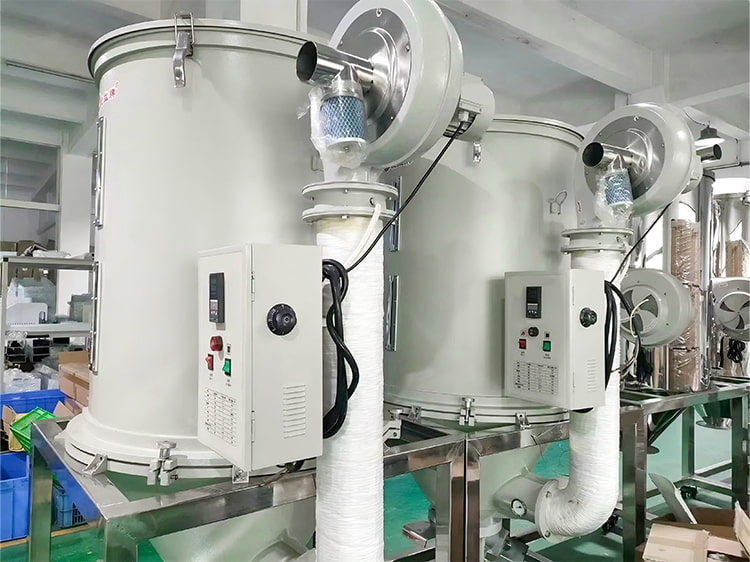
Before the plastic even touches the injection machine, it should go through a controlled drying process. This is where the Audop Plastic Hopper Dryer comes into play.
These dryers work by circulating hot, dehumidified air through the plastic pellets, driving out moisture thoroughly and evenly. The result?
- Improved part quality: No more bubbles or splay.
- Better mechanical performance: Polymer chains stay intact.
- Consistent production: Stable melt flow and predictable cycle times.
- Clean and Stable, Ensuring Material Purity:The internal and external surfaces that come into contact with the material are made of stainless steel, meeting food-grade and medical-grade standards, preventing material contamination. The exterior is constructed from precision die-cast aluminum, offering excellent heat retention properties and reducing heat loss, ensuring consistent drying efficiency. Optional air filters can effectively remove impurities from the air, preventing secondary contamination during the drying process.
- Safe and Flexible, Suitable for Automated Production:The electric heating cylinder features a bent design, preventing the accumulation of material dust and reducing the risk of combustion, enhancing safety. The aluminum die-cast mold allows the hopper to flip back, supporting robotic arms for material loading and unloading, making it compatible with automated production lines.
- Precise and Controllable, Ensuring Quality and Safety:The Audop Plastic Hopper Dryer is equipped with precise temperature control, allowing for the adjustment of the optimal drying temperature based on the characteristics of different materials. This prevents degradation due to excessive temperatures or moisture retention from insufficient drying. The transparent viewing window allows operators to monitor the drying status in real-time, ensuring complete moisture removal.
- User-Friendly Design for Optimized Operation:The dryer is equipped with a silent fan, effectively reducing production noise. Its compact design and efficient layout balance high drying efficiency and ease of operation, helping enterprises improve production continuity and overall efficiency.
A high-efficiency dryer like the Audop Plastic Hopper Dryer not only ensures proper drying but also offers energy-saving designs, easy maintenance, and smart temperature control. This makes it a go-to solution for manufacturers aiming for reliability and cost efficiency.
Practical Tips for Moisture Control
- Know your material: Check the recommended drying temperature and time for each resin type.
- Use a moisture analyzer: Don't guess-measure.
- Keep pellets sealed: Store them in airtight containers or use vacuum packaging.
- Avoid long residence time: Don't let dried pellets sit too long in the hopper, or they'll reabsorb moisture.
- Regular maintenance: Keep your drying equipment clean and calibrated.
Conclusion
In injection molding, moisture may be small, but its impact is enormous. It affects aesthetics, strength, and process stability-all the things that define product quality. With the right drying technology, such as a reliable hopper dryer, manufacturers can easily eliminate moisture-related issues and keep their molding lines running smoothly.
When it comes to plastics, dry is strong-and a properly dried material is the foundation of every perfect molded part.